
BCBA to RBA in Ontario: Everything You Need to Know About the Transition to CPBAO Regulation (2026 Update)

If you've recently become a Registered Behaviour Analyst (RBA) - or you're planning your career in behaviour analysis - you've probably found yourself navigating a significant amount of change.
Ontario's regulation of Applied Behaviour Analysis (ABA) has transformed how Behaviour Analysts become credentialed, supervised, and regulated. For many clinicians who trained under the Behavior Analyst Certification Board (BACB) model, the transition has raised important questions.
Do I still need my BCBA?
Can I call myself a BCBA?
What changed with supervision?
What is JECAABA?
What is the OEPPABA?
Can Ontario residents still become BCBAs?
This guide summarizes the most important changes every Ontario Behaviour Analyst should know.

Why Did Ontario Change?
On July 1, 2024, the profession of Behaviour Analysis became regulated under Ontario's Psychology and Applied Behaviour Analysis Act, 2021.
This means that "Behaviour Analyst" became a protected professional title.
Today, anyone wishing to practise as a Behaviour Analyst in Ontario must be registered with the College of Psychologists and Behaviour Analysts of Ontario (CPBAO). (CPBAO)
The goal of regulation is public protection through standardized education, ethical practice, accountability, and oversight.
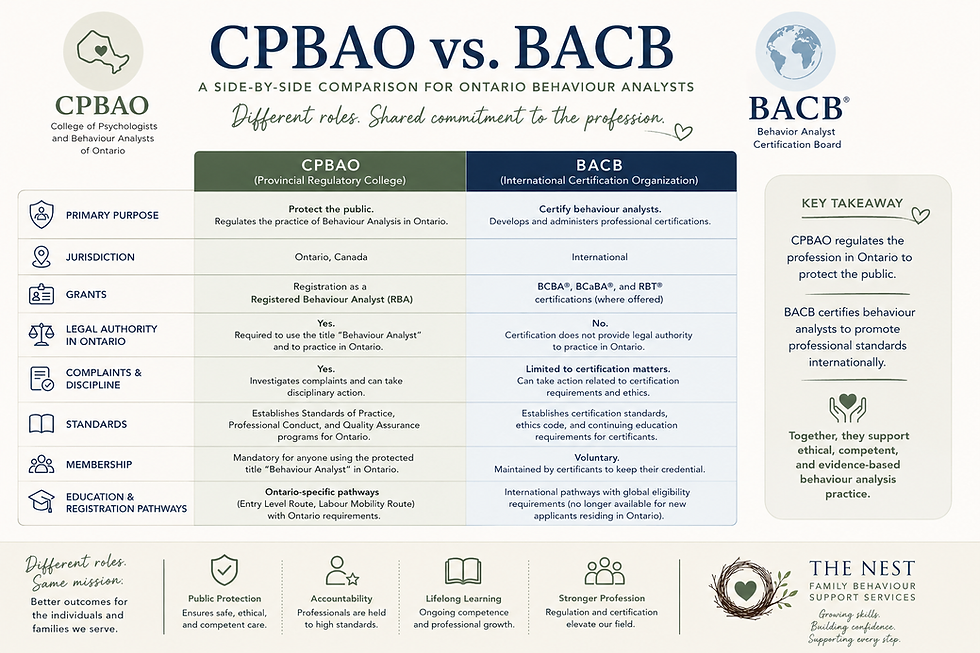
BCBA vs. RBA: What's the Difference?
One of the biggest misconceptions is that the BCBA simply changed its name.
It didn't.
The BCBA is an international professional certification issued by the Behavior Analyst Certification Board (BACB).
The RBA is a provincial registration issued by the College of Psychologists and Behaviour Analysts of Ontario (CPBAO).
Think of it this way:
BCBA | RBA |
Professional certification | Provincial registration |
Issued by the BACB | Issued by CPBAO |
International credential | Legal authorization to practise as a Behaviour Analyst in Ontario |
Voluntary to maintain | Required to use the protected title "Behaviour Analyst" in Ontario |
Many clinicians currently hold both credentials.
The Biggest Changes Ontario Clinicians Should Know
1. Ontario Is No Longer Using the BACB Pathway for New Behaviour Analysts
Perhaps the biggest change is that Ontario residents can no longer begin the BCBA certification pathway through the BACB.
As of July 1, 2026, Ontario applicants must register through CPBAO's registration pathways rather than pursuing initial BCBA certification while residing in Ontario. Existing BCBAs may continue to maintain their certification if they choose. (Behavior Analyst Certification Board)
2. Transitional Registration Has Ended
When regulation first came into effect, CPBAO created two temporary transitional pathways for experienced Behaviour Analysts.
These pathways officially closed on June 30, 2026.
Today, new applicants register through one of two routes:
Entry Level Route
Labour Mobility Route
The transitional pathways are no longer accepting new applications. (CPBAO)
3. Supervised Practice Has Changed
One of the most significant differences between the former BACB pathway and Ontario's Entry Level Route is when supervised practice hours can begin.
Under the current CPBAO Entry Level Route, applicants begin accruing supervised practice only after entering the College's supervised practice registration process. This differs from the historical BACB pathway, where fieldwork hours could often be accumulated while completing approved coursework. (CPBAO)
For many students, this represents one of the largest structural changes in becoming a Behaviour Analyst in Ontario.
4. Ontario Has Its Own Jurisprudence and Ethics Requirements
Ontario Behaviour Analysts are now expected to demonstrate knowledge of provincial legislation, ethics, standards of practice, and professional responsibilities.
Depending on the registration pathway, this includes:
JECAABA (Jurisprudence and Ethics Course and Assessment in Applied Behaviour Analysis)
OEPPABA (Ontario Examination for Professional Practice in Applied Behaviour Analysis)
These assessments focus on practising safely and ethically within Ontario's regulated healthcare system - not simply behaviour analytic knowledge. (CPBAO)
5. Regulation Means Ongoing Accountability
Perhaps the most important change isn't educational—it's professional.
As Registered Behaviour Analysts, clinicians are accountable to a regulatory college whose mandate is public protection.
This includes:
Standards of Professional Conduct
Standards of Practice
Continuing competence requirements
Professional accountability
Complaints and discipline processes
Quality assurance expectations
Like psychologists, occupational therapists, and speech-language pathologists, Behaviour Analysts are now members of a self-regulated health profession.
Should You Keep Your BCBA?
One of the most common questions among Ontario clinicians is whether it's worth maintaining BCBA certification.
The answer depends on your career goals.
Maintaining BCBA certification may be beneficial if you:
Plan to work outside Ontario
Intend to relocate to another province or country
Provide services internationally
Value maintaining an internationally recognized credential
If your career will remain exclusively within Ontario, your legal authority to practise as a Behaviour Analyst comes from your CPBAO registration. Existing certificants may continue maintaining their BCBA if they wish, but new Ontario residents can no longer begin initial BCBA certification through the BACB. (CPBAO)
What Hasn't Changed?
Although the regulatory framework has changed, the core principles of behaviour analysis remain the same.
Behaviour Analysts continue to:
Conduct behavioural assessments
Develop individualized treatment plans
Analyze data
Supervise clinical implementation
Coach caregivers
Use evidence-based interventions
Improve socially significant outcomes for clients
The science hasn't changed.
The system that governs the profession has.
Looking Ahead
Ontario's regulation of Behaviour Analysis represents an important milestone in the profession's growth.
While the transition from BCBA to RBA has required clinicians to adapt to new registration pathways, examinations, and professional expectations, it also brings greater recognition, accountability, and public confidence in Behaviour Analysis as a regulated healthcare profession.
As the profession continues to evolve, staying informed about CPBAO standards, legislative updates, and professional responsibilities will be an essential part of practicing as an RBA in Ontario.
Whether you're a student preparing to enter the field, a newly registered RBA, or an experienced clinician navigating the post-regulation landscape, understanding these changes will help you build a strong foundation for your professional career.


Comments