
OEPPABA Study Guide & Tips: How to Prepare for Ontario's Professional Practice Examination

If you're working toward becoming a Registered Behaviour Analyst (RBA) in Ontario, you've likely heard about the Ontario Examination for Professional Practice in Applied Behaviour Analysis (OEPPABA).
For many applicants, this examination can feel intimidating—not because it tests behaviour analytic concepts you've already mastered, but because it focuses on something different: professional practice in Ontario.
The good news? With the right preparation and a solid understanding of the exam's purpose, you can approach the OEPPABA with confidence.
This guide outlines what the examination is designed to assess, how to prepare effectively, and practical strategies to help you succeed.

What Is the OEPPABA?
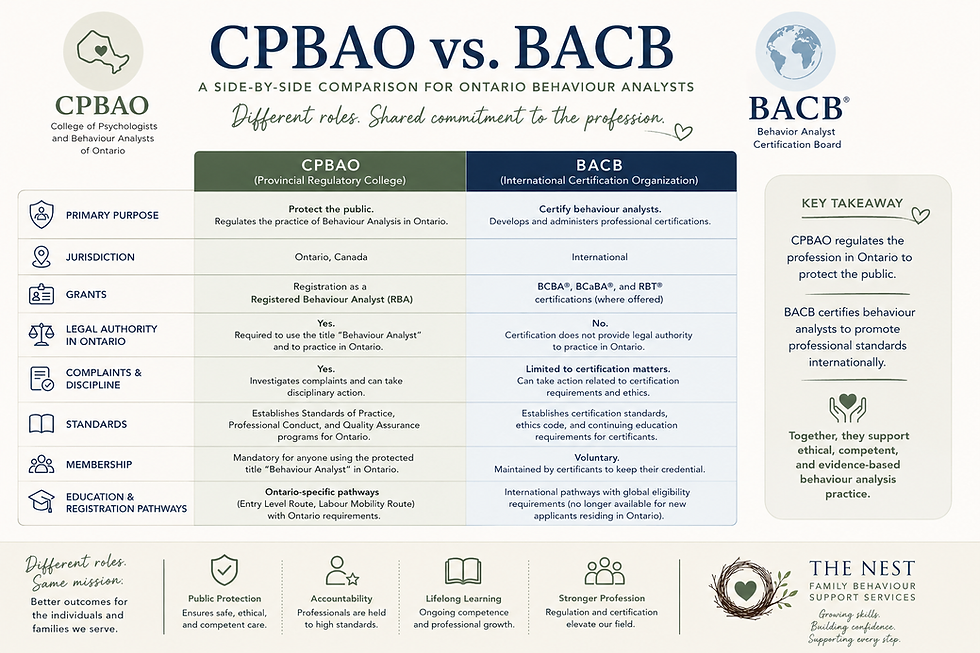
The Ontario Examination for Professional Practice in Applied Behaviour Analysis (OEPPABA) is part of the registration process for Behaviour Analysts through the College of Psychologists and Behaviour Analysts of Ontario (CPBAO).
Unlike competency examinations that evaluate behaviour analytic knowledge or intervention strategies, the OEPPABA focuses on professional practice.
The examination assesses whether applicants understand the legal, ethical, and professional responsibilities required to practice safely as a regulated health professional in Ontario.
Its purpose aligns with the College's mandate:
Protecting the public by ensuring Behaviour Analysts understand the standards governing professional practice in Ontario.
What Does the OEPPABA Focus On?
Although the exact examination content is determined by CPBAO, applicants should expect questions related to professional judgment rather than memorization.
Key areas include:
Professional Ethics
Understand how ethical principles guide clinical decision-making.
Topics may include:
Professional integrity
Respect for clients
Confidentiality
Informed consent
Professional boundaries
Conflicts of interest
Rather than asking you to memorize policies, the examination is more likely to assess how you would apply ethical principles in realistic practice scenarios.
Ontario Legislation
Behaviour Analysts work within a legal framework.
Become familiar with legislation and regulatory requirements that affect professional practice, including those identified by CPBAO.
Examples include legislation related to:
Privacy
Consent
Record keeping
Regulated health professions
Professional accountability
You don't need to become a lawyer—but you should understand how legislation influences everyday clinical practice.
Standards of Practice
One of the most important study areas is CPBAO's Standards of Practice.
These standards outline expectations regarding:
Assessment
Documentation
Clinical decision-making
Supervision
Communication
Professional responsibilities
Competence
Client-centred practice
As you read the standards, ask yourself:
"What would this look like during a normal workday?"
Thinking practically will help you apply the concepts more effectively.
Professional Judgment
Many questions are designed to evaluate your ability to make sound professional decisions.
You may be asked to consider situations involving:
Ethical dilemmas
Dual relationships
Documentation concerns
Supervision decisions
Client safety
Communication with families or other professionals
Instead of searching for the "perfect" answer, think about which option best protects the client while aligning with professional standards.
How to Study Effectively
1. Start with CPBAO Resources
Your first source of information should always be the resources published by CPBAO.
These documents outline the expectations for registered Behaviour Analysts and provide the foundation for professional practice in Ontario.
Focus on understanding the concepts—not simply reading them once.
2. Understand the "Why"
Don't memorize individual rules.
Instead, ask:
Why does this standard exist?
Who is being protected?
What could happen if this standard isn't followed?
Understanding the purpose behind professional standards makes them much easier to remember and apply.
3. Practice Scenario-Based Thinking
Professional practice examinations often require applicants to apply principles to real-world situations.
As you study, create your own scenarios.
For example:
A parent requests information about another client.
A supervisee asks you to sign off on hours you didn't supervise.
You discover a documentation error after submitting a report.
A family offers an expensive gift.
Ask yourself:
What issues are present?
Which professional standards apply?
What action best protects the client?
How would I document my decision?
This style of preparation builds clinical reasoning rather than rote memorization.
4. Study the Standards of Practice Slowly
Instead of trying to finish the Standards of Practice in one sitting, divide them into manageable sections.
For each section:
Summarize it in your own words.
Think of an example from practice.
Discuss it with a colleague or mentor.
Identify how it relates to public protection.
Teaching concepts to someone else is one of the best ways to reinforce your own understanding.
5. Review Professional Boundaries
Boundary questions are common in healthcare professional examinations because they reflect everyday clinical situations.
Review examples involving:
Social media
Gifts
Personal relationships
Dual relationships
Financial conflicts
Professional communication
Remember that boundaries exist to protect both clients and professionals.
Common Mistakes to Avoid
Many applicants spend too much time reviewing behaviour analytic procedures while overlooking professional practice.
Keep in mind:
❌ Memorizing legislation without understanding its application
❌ Ignoring documentation standards
❌ Assuming ethical questions always have obvious answers
❌ Focusing only on clinical intervention
❌ Waiting until the last minute to read CPBAO materials
Instead, prepare by thinking like a regulated healthcare professional.
Exam-Day Tips
Before the examination:
Get adequate sleep.
Eat beforehand.
Arrive early if writing in person.
Read each question carefully.
Pay attention to qualifying words such as most appropriate, best, or initial.
If you're unsure of an answer:
Eliminate clearly incorrect options.
Think about public protection.
Consider client safety.
Reflect on professional accountability.
Choose the response that best aligns with CPBAO standards.
Often, the correct answer is the one that most effectively protects the client while maintaining ethical and professional practice.
Final Thoughts
Preparing for the OEPPABA isn't about memorizing hundreds of facts.
It's about developing the mindset of a regulated healthcare professional.
As Behaviour Analysts in Ontario, our responsibility extends beyond providing evidence-based interventions. We are expected to exercise sound professional judgment, uphold ethical standards, maintain accountability, and place the well-being of our clients at the centre of every decision.
Approach your preparation with curiosity rather than anxiety.
By understanding the principles behind Ontario's professional standards—and practicing how to apply them—you'll be well prepared not only for the examination, but for your future career as a Registered Behaviour Analyst.
Additional Resources
To support your preparation, consider reviewing:
CPBAO Standards of Practice
Professional Conduct resources
Quality Assurance information
Registration Guides
Jurisprudence and Ethics resources
Relevant Ontario legislation referenced by CPBAO
The goal isn't simply to pass the examination—it's to begin your career with a strong foundation for ethical, competent, and client-centred practice.


Comments